Submission Guidelines Announcement
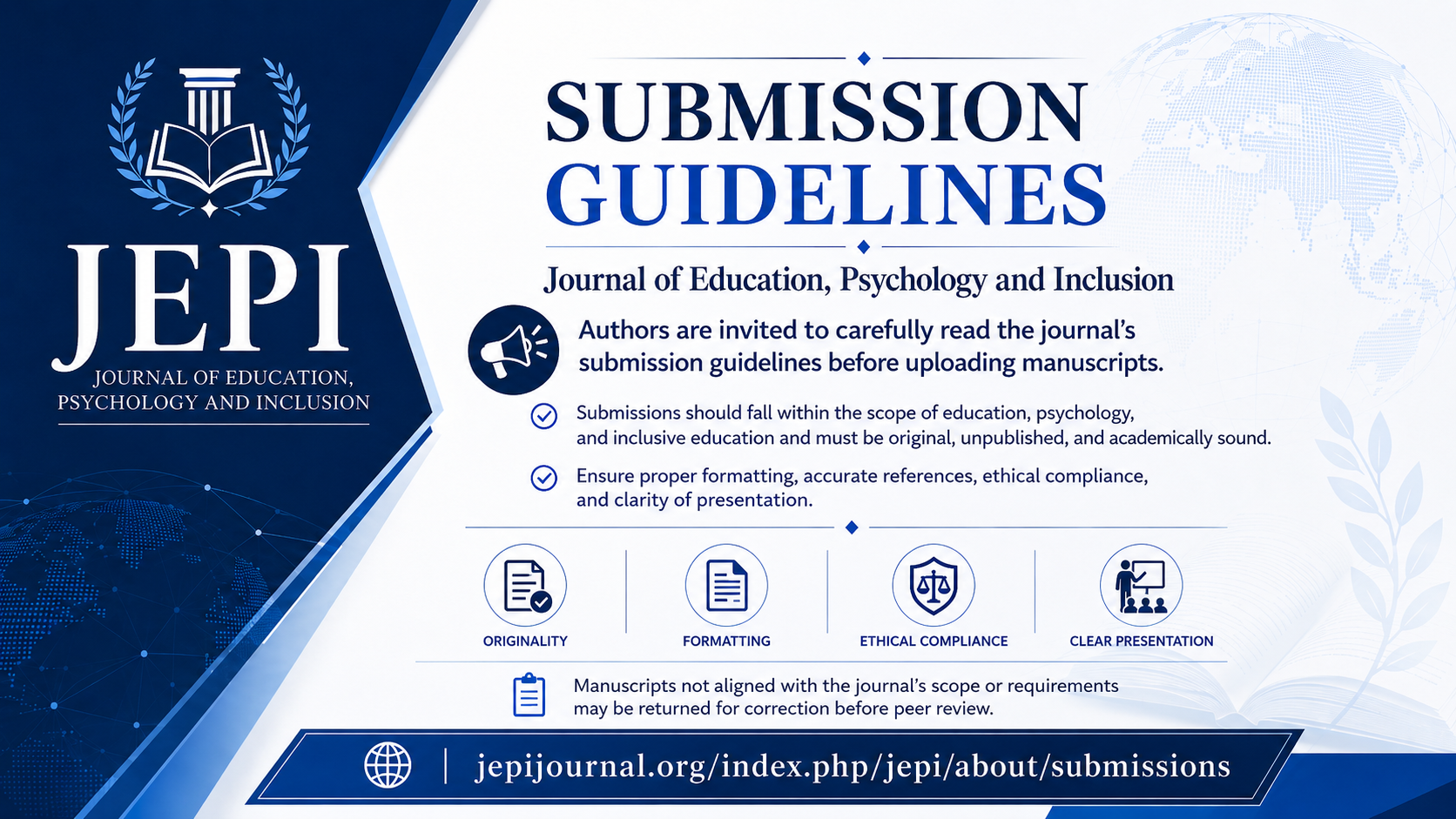
The Journal of Education, Psychology and Inclusion (JEPI) welcomes high-quality scholarly submissions in the fields of education, psychology, and inclusive education. These guidelines are intended to help authors prepare and submit manuscripts in a clear, consistent, and academically appropriate manner.
Authors are requested to read these guidelines carefully before submission. Compliance with the journal’s requirements supports efficient editorial processing and peer review.
2. Scope of the JournalJEPI publishes work related to areas including, but not limited to:
-
education and pedagogy
-
curriculum and instruction
-
educational psychology
-
learning, cognition, and motivation
-
child and adolescent development
-
guidance and counselling
-
teacher education
-
diversity, equity, and inclusion
-
special and inclusive education
-
neurodiversity and learner support
-
mental health and wellbeing in educational contexts
-
interdisciplinary issues connected to education, psychology, and inclusion
JEPI accepts the following categories of submissions:
-
Research Articles
-
Review Articles
-
Conceptual Papers
-
Case Studies
-
Short Communications
-
Book Reviews
-
Editorials by invitation or editorial decision
Submitted manuscripts must be:
-
original and unpublished
-
not under review or consideration elsewhere
-
free from plagiarism, fabrication, falsification, and unethical authorship practices
-
relevant to the aims and scope of the journal
Authors are responsible for ensuring the originality of the manuscript and for properly acknowledging all sources used.
5. LanguageManuscripts should be written in clear, formal, and scholarly English. Authors should ensure that the language is grammatically accurate and suitable for academic publication. Submissions with serious language or presentation problems may be returned for revision before peer review.
6. Manuscript PreparationA manuscript should generally include the following parts:
6.1 TitleThe title should be concise, informative, and clearly reflect the content of the paper.
6.2 Author InformationAuthors should provide:
-
full name
-
institutional affiliation
-
email address
-
country
-
ORCID, where available
Each manuscript should include an abstract of approximately 150–250 words summarizing the purpose, method, key findings, and significance of the study or paper.
6.4 KeywordsAuthors should provide 4 to 6 keywords representing the major concepts of the manuscript.
6.5 Main TextThe main text should be well organized. Depending on the nature of the submission, it may include:
-
introduction
-
review of literature
-
objectives or research questions
-
methodology
-
results or analysis
-
discussion
-
conclusion
-
implications
-
references
Tables, figures, charts, and illustrations should:
-
be clearly numbered
-
carry appropriate titles or captions
-
be cited in the text
-
be relevant and of publishable quality
Authors should use a simple and professional manuscript format:
-
readable font
-
consistent heading structure
-
adequate line spacing
-
page numbers
-
properly formatted tables and references
A standard academic format should be followed throughout the manuscript. The editorial office may make minor style adjustments for consistency.
8. Citation and ReferencingAuthors should use a consistent academic citation style throughout the manuscript. JEPI prefers APA style (7th edition) unless otherwise specified by the journal.
Authors are responsible for ensuring:
-
accuracy of in-text citations
-
completeness of references
-
proper correspondence between citations and the reference list
Authors must ensure that:
-
the manuscript is their original work
-
all sources are properly cited
-
all listed authors have made a genuine academic contribution
-
the manuscript has not been submitted simultaneously elsewhere
-
permissions for copyrighted materials have been obtained where necessary
-
ethical clearance has been secured where the study involves participants, institutions, or sensitive data
JEPI takes plagiarism and other forms of academic misconduct seriously. Submitted manuscripts may be screened for similarity and plagiarism before or during editorial review. Manuscripts with significant plagiarism or unethical overlap may be rejected.
11. Submission ProcessAuthors should submit manuscripts through the journal’s online submission system. During submission, authors may be required to:
-
select the appropriate journal section
-
upload the manuscript file
-
upload supplementary files, if any
-
provide metadata including title, abstract, and keywords
-
confirm compliance with journal requirements
Authors are advised to check all entered information carefully before final submission.
12. Editorial ScreeningAll submissions undergo an initial editorial review to determine whether the manuscript:
-
fits the journal’s scope
-
meets minimum academic and formatting standards
-
follows ethical expectations
-
is suitable to proceed for peer review
Manuscripts that do not meet these requirements may be returned for technical correction or declined at the preliminary stage.
13. Peer ReviewManuscripts that pass editorial screening are sent for peer review according to the journal’s review procedure. Reviewers assess originality, relevance, clarity, rigor, and contribution to the field. Editorial decisions are based on reviewer feedback and editorial judgment.
14. Revision and ResubmissionAuthors may be requested to revise their manuscripts in response to editorial or reviewer comments. Revised submissions should address the comments carefully and be resubmitted within the specified period.
15. Copyright and PermissionsAuthors are responsible for ensuring that submitted content does not violate copyright or other legal rights. Any material reproduced from other sources must be accompanied by appropriate acknowledgement and permission where required.
16. Open AccessJEPI follows an open access model. Published articles are made freely available to readers in order to encourage broader dissemination of knowledge and research visibility.
17. PrivacyPersonal information submitted to the journal, including names and email addresses, will be used only for the academic and administrative purposes of the journal.
18. Final Note to AuthorsAuthors are encouraged to submit well-prepared, original, and meaningful manuscripts that contribute to scholarship in education, psychology, and inclusion. Careful adherence to the journal’s guidelines will facilitate timely editorial processing and strengthen the quality of academic communication.