Peer Review, Publication Ethics and Research Integrity at JEPI
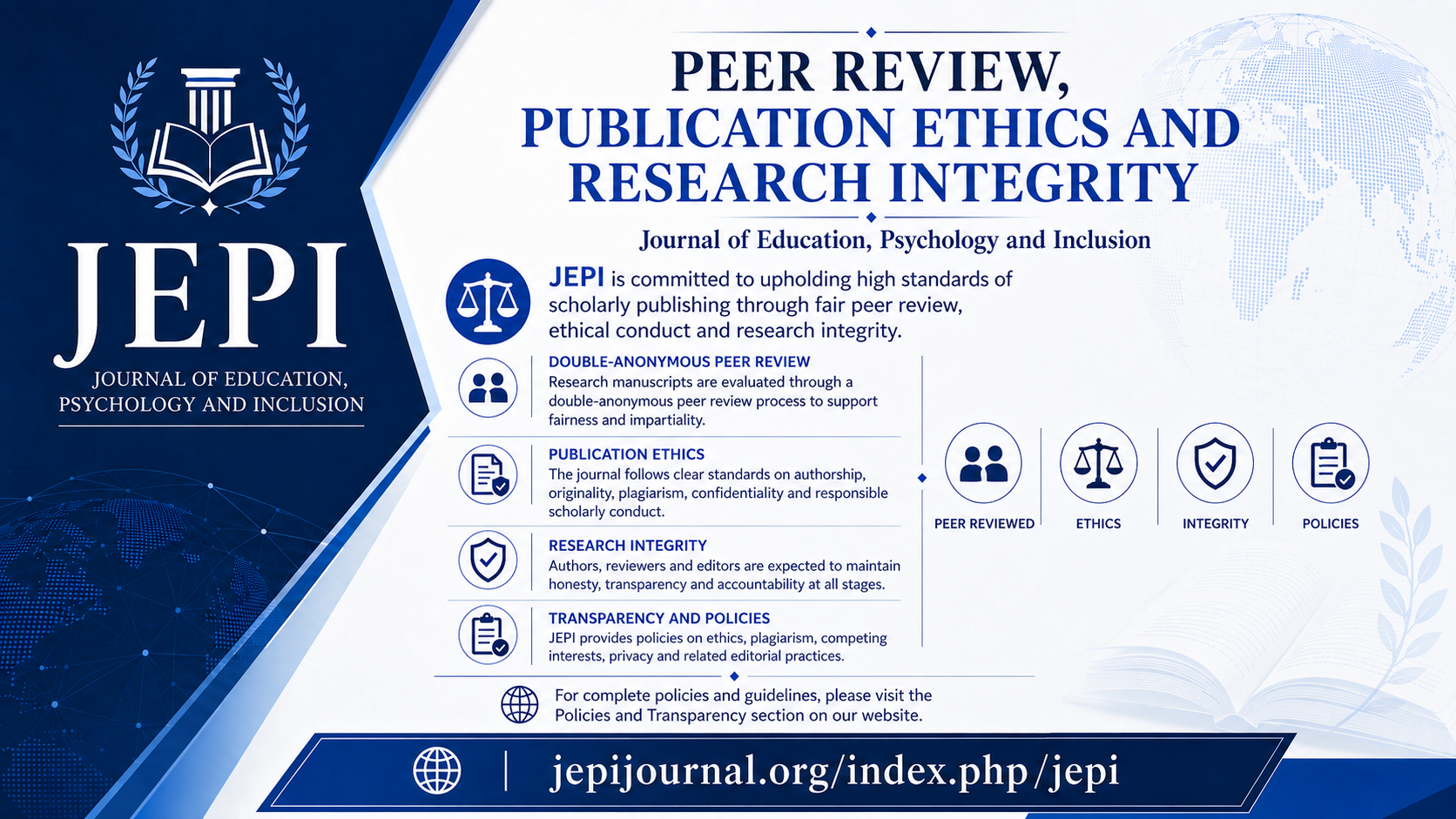
The Journal of Education, Psychology and Inclusion (JEPI) is committed to maintaining academic quality, editorial independence, fair peer review and responsible scholarly publishing.
Manuscripts that pass initial editorial screening are ordinarily evaluated through double-anonymous peer review, under which the identities of authors and reviewers are not disclosed to one another during the review process. Authors are therefore expected to submit an anonymised manuscript that does not contain names, affiliations, acknowledgements or other unnecessary identifying information.
Each research manuscript will normally be evaluated by at least two suitably qualified reviewers. Reviewers assess the originality, significance, conceptual clarity, engagement with relevant scholarship, methodological appropriateness, ethical soundness, quality of analysis, validity of conclusions and contribution of the manuscript to education, psychology, inclusion or related interdisciplinary fields.
Reviewer recommendations are advisory. Final decisions regarding acceptance, revision, resubmission or rejection remain the responsibility of the editor. Editorial decisions are based on scholarly merit and are not influenced by the author’s nationality, institutional affiliation, professional status, financial circumstances, gender, disability, religion, ethnicity, political position or personal relationships.
JEPI requires all authors, reviewers, editors and editorial-board members to comply with recognised principles of publication ethics and research integrity. The journal does not tolerate plagiarism, fabrication, falsification, duplicate submission, redundant publication, citation manipulation, inappropriate authorship, peer-review manipulation, undisclosed competing interests, unethical research or the improper use of artificial-intelligence tools.
All submitted manuscripts may be examined through similarity-detection software. A similarity score is used as a screening indicator and is not treated as automatic proof of plagiarism. The editorial team considers the extent, location, nature and context of any overlap before reaching a decision.
Authors must ensure that all listed authors have made genuine scholarly contributions, approved the final manuscript and accepted responsibility for the integrity of the work. Gift, honorary, guest and ghost authorship are prohibited. Artificial-intelligence systems cannot be listed as authors.
Relevant financial and non-financial competing interests must be disclosed. Where no competing interests exist, authors should state: “The authors declare that they have no competing interests.”
Research involving human participants, identifiable information, vulnerable groups or sensitive data must comply with applicable ethical requirements. Authors should report ethics approval, informed consent, participant safeguards and confidentiality arrangements where relevant. Animal research must comply with appropriate institutional and legal welfare standards.
Material use of generative artificial intelligence in manuscript preparation, translation, coding, analysis, image creation or other substantive tasks must be disclosed. Authors remain fully responsible for the accuracy, originality, citations, interpretation and integrity of all submitted content. Artificial intelligence must not be used to fabricate data, participants, references, results or evidence.
Reviewers and editors must treat manuscripts as confidential documents. They must not share unpublished material, use it for personal advantage or upload confidential submissions into unauthorised artificial-intelligence systems.
Where concerns relating to misconduct arise, JEPI may request explanations, original data, ethics documents, authorship records, similarity reports or other supporting evidence. Editorial processing may be suspended while the matter is examined.
Depending on the seriousness and timing of the concern, the journal may reject a manuscript, withdraw an acceptance, require correction, publish an expression of concern, retract an article, notify relevant institutions or take other proportionate action necessary to protect the scholarly record.
JEPI distinguishes between honest error and deliberate misconduct and seeks to handle all concerns fairly, confidentially and transparently.
Authors, reviewers and readers are encouraged to consult the journal’s complete policy framework before participating in the submission, review or publication process.
Peer Review Policy: https://jepijournal.org/index.php/jepi/Peer-Review-Policy
Publication Ethics and Malpractice Statement: https://jepijournal.org/index.php/jepi/publication-ethics
Plagiarism Policy: https://jepijournal.org/index.php/jepi/Plagiarism-Policy
Competing Interests Policy: https://jepijournal.org/index.php/jepi/Competing-Interests
Policies and Transparency: https://jepijournal.org/index.php/jepi/policies
Editorial Contact: editor@jepijournal.org